

One of the first questions readers ask me after finishing Bound by Secrets is:
“Is that rare book real?”
The short answer is…
Parts of it are.
One of my favorite things about writing cozy mysteries is weaving real history into fictional stories. I love taking something readers may have heard about, adding a little imagination, and building a mystery around it.
For Bound by Secrets, that meant diving into the fascinating world of rare books.
I knew from the beginning that I didn’t want the mystery to revolve around hidden jewels, buried money, or a long-lost fortune.
I wanted the treasure itself to be a book.
Not because books are valuable simply as objects, but because they carry history in a way almost nothing else can.
More Than Paper and Ink
Most people look at an old book and see…
An old book.
Collectors see something entirely different.
They notice the publisher.
The year it was printed.
The binding.
The condition of the dust jacket.
The edition statement.
The printing history.
The signatures.
Even the smallest printing error can completely change a book’s value.
That fascinated me.
Books aren’t just stories.
They’re historical artifacts.
Every crease, handwritten inscription, library stamp, or coffee stain tells part of that book’s journey.
Who owned it?
Who loved it?
Where has it traveled?
How did it survive for decades or even centuries?
Those questions are often just as interesting as the story printed inside.
The Rare Huckleberry Finn
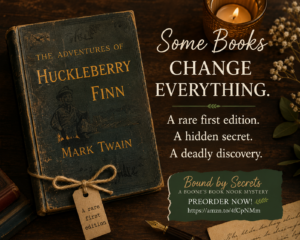
The rare edition featured in Bound by Secrets was inspired by real collectible editions that have become highly sought after because of tiny printing differences. In the novel, the mystery centers on a valuable edition identified by a specific printing error that dramatically increases its worth. That idea grew out of real publishing history, where seemingly minor variations can make one copy far more desirable than another. The series materials identify the featured edition by a page 57 typo that collectors recognize as exceptionally valuable.
When I first learned about collectible printings, I was amazed.
Imagine walking into a thrift store.
Buying a dusty old novel for a few dollars.
Only to discover later that it’s worth tens of thousands.
That sounds like something made up for fiction.
It isn’t.
Stories like that happen.
Not every day, of course.
But often enough that collectors never stop looking.
And that’s exactly what made it perfect for a mystery.
Learning the Language of Collectors
One thing I quickly discovered while researching was that rare book collecting has its own vocabulary.
First edition.
First printing.
Provenance.
Foxing.
Deckled edges.
Association copy.
Facsimile.
Dust jacket.
Binding.
Ex libris.
At first, it felt overwhelming.
But the more I learned, the more I realized collectors aren’t simply buying books.
They’re preserving history.
Every book has a biography beyond the story written on its pages.
Some traveled through generations of one family.
Others sat forgotten in attics.
Some belonged to famous people.
Others quietly waited on thrift store shelves until someone recognized what they really were.
That hidden history fascinated me.
Why Book Condition Matters
Another thing I learned is that condition changes everything.
Two identical books printed the same year can have wildly different values.
One may have torn pages, water damage, missing covers, or heavy writing inside.
Another might look as though it just left the printing press.
Collectors notice every detail.
Even something as simple as an original dust jacket can make an enormous difference.
As a reader, I understand loving a well-worn book that’s been read a dozen times.
As a researcher, I discovered collectors sometimes treasure books for entirely different reasons.
Both perspectives are valid.
They’re simply appreciating books in different ways.
The Treasure Hunt
Researching rare books reminded me that collecting is really about hope.
Hope that today’s yard sale holds tomorrow’s incredible discovery.
Hope that the forgotten box in the corner contains something remarkable.
Hope that one overlooked book has a story nobody else noticed.
I think that’s why so many readers love antique stores, flea markets, estate sales, and thrift shops.
You never know what you’ll find.
That’s certainly true in Normal.
Buck Davis’s Tough Nickel isn’t just a thrift store.
It’s a treasure hunt.
Every shelf offers possibilities.
Every dusty box deserves another look.
Readers quickly learn that in Normal, valuable things often hide in ordinary places.
Research Rabbit Holes
I’ll confess something.
Research is dangerous.
Not because it’s difficult.
Because it’s fun.
I’ll sit down intending to spend twenty minutes reading about first editions.
Three hours later, I’m learning about Victorian bookbinding techniques, antique bookplates, or the history of handwritten ownership inscriptions.
One fascinating fact leads to another.
Before long, I’ve wandered into an entirely different century.
I suspect many of you understand exactly what I mean.
Book lovers are naturally curious people.
The Stories Behind the Stories
One thing that surprised me most was realizing every rare book carries two stories.
The first is the one printed inside.
The second is everything that happened after publication.
Who bought it first?
Who gave it as a gift?
Who carefully protected it?
Who nearly threw it away?
Who rediscovered it decades later?
Sometimes those untold stories become just as fascinating as the novel itself.
That realization heavily influenced Bound by Secrets.
The mystery isn’t simply about a valuable book.
It’s about the lives connected to it.
Fiction Meets Reality
Whenever I write mysteries involving specialized topics, I try to strike a balance.
I want readers to learn something.
I never want them to feel like they’re reading a textbook.
The rare book research became seasoning rather than the entire meal.
Enough to make the mystery believable.
Not so much that it slowed the story.
If reading Bound by Secrets inspires someone to visit an independent bookstore, browse an antique shop, or look a little more closely at the books already sitting on their own shelves, then I consider that a wonderful bonus.
My Favorite Discovery
People often ask what my favorite part of the research was.
Honestly?
It wasn’t discovering how much certain books are worth.
It was realizing how many incredible stories still exist quietly on library shelves, inside family collections, and tucked away in small-town bookstores.
Books connect generations.
They survive wars.
Moves.
Families.
Time.
They’re patient.
Sometimes they wait decades before the right reader discovers them.
There’s something wonderfully hopeful about that.
Looking at Books Differently
Since writing Bound by Secrets, I don’t browse bookstores the same way.
I notice old bindings.
Handwritten inscriptions.
Interesting editions.
Local history shelves.
Forgotten classics.
Books that someone clearly loved before they found their way onto another shelf.
Every old book makes me wonder.
Who held this before me?
Where has it been?
What conversations has it witnessed?
What secrets might it carry?
Those questions are exactly what led me to write this mystery.
Because sometimes the greatest treasure isn’t hidden inside a vault.
Sometimes it’s quietly waiting on a bookshelf.
All it needs is someone curious enough to open the cover.
Reader Discussion
I’d love to hear from you!
Have you ever discovered an unexpected treasure in a used bookstore, thrift shop, or estate sale?
Do you own any books that are especially meaningful to you?
If you could own one famous rare book, what would it be?
Do you enjoy visiting independent bookstores or antique bookshops.